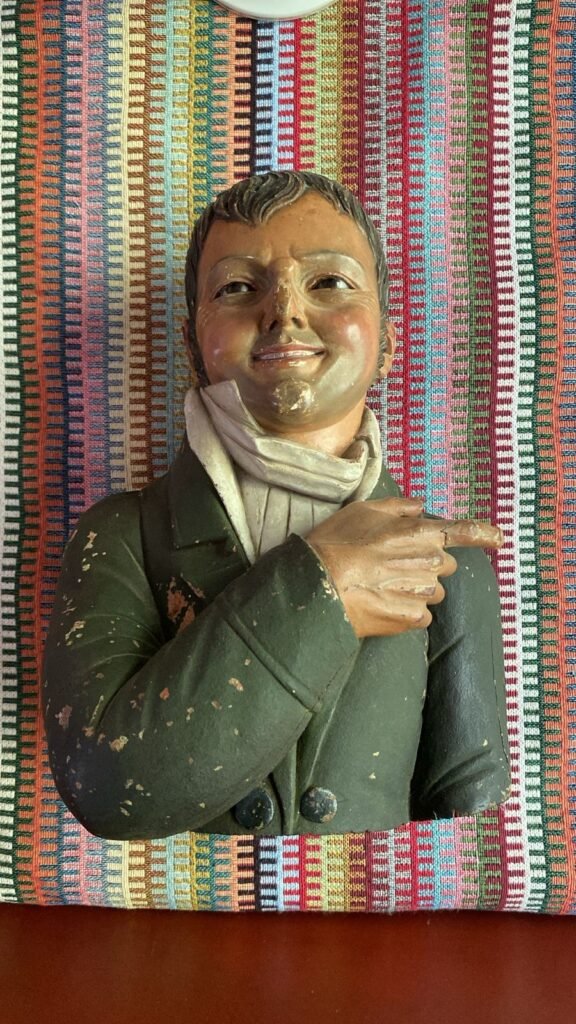
A rare late 18th to early 19th-century carved and polychromed wooden bust of a smiling gentleman in civilian clothing
Visual Details
Description
The figure depicts a man with a mischievous, complicit smile, pointing his index finger. He wears fashion typical of the Neoclassical/Empire period: a high-knotted white cravat, a fitted green jacket with lapels, and hair styled forward (“Titus” style). The skin tone is achieved using the highly realistic “encarnado” technique, showing a slight blush, glossy eyes, and visible teeth. Natural wear reveals a white gesso preparation base underneath the paint
The Subject
Latin American folk art; Secular wood carving; Antique trade signs; Historical fashion (Empire/Regency).
Technical Specifications
Likely a master of the Quito School or a European import
Carved and polychrome hardwood (likely cedar or walnut), gesso base, “encarnado” technique
Circa 1790-1830
Ecuador (Quito School) or possibly Spain/Italy
Historical Significance
An extremely rare piece of secular or civil art in Latin America, where religious imagery overwhelmingly dominated. The clothing, pose, and pointing finger strongly suggest it served as a 3D trade sign or shop figure (reclamo comercial) to invite customers into an elegant store, tailor, or tavern during the early Republican era
Explore the School of Athens Series
Inquiry & Acquisition
Condition Reports.
Detailed descriptions of paper quality, margins, and preservation state.
Provenance.
Direct history of the collection’s origin.
Secure Global Shipping.
Expertly packed and insured delivery to international collectors and institutions.