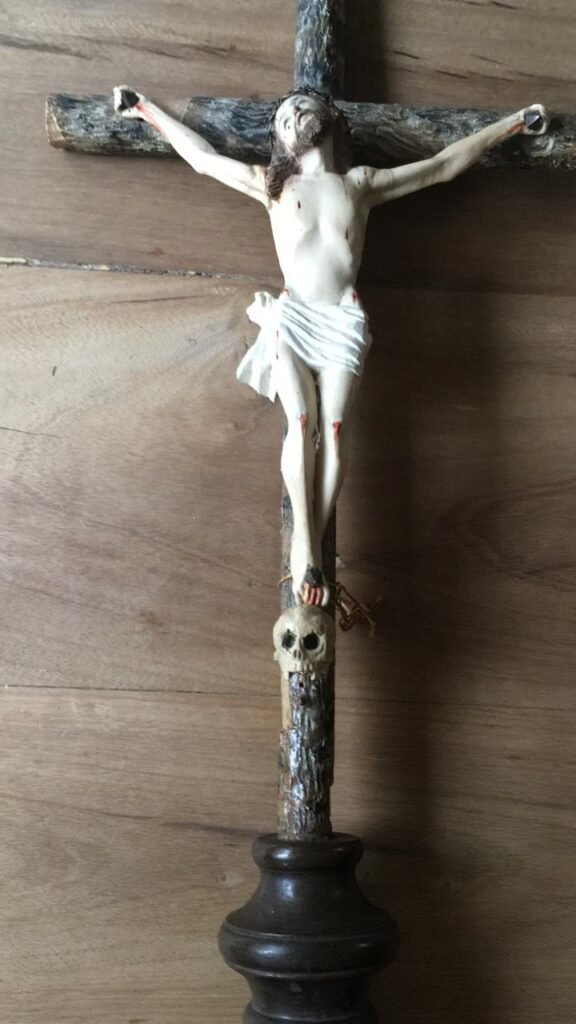
A highly realistic Colonial Baroque wood carving from the Quito School depicting Christ’s final agony
Visual Details
Description
Christ is shown alive, looking upwards with parted lips, capturing the exact moment of his final breath rather than after death. The skin features a brilliant “encarnado” finish, achieved by rubbing the oil paint with a sheep’s bladder to simulate sweat and tension. The sculpture includes hyper-realistic additions (“postizos”) such as inserted glass eyes and a real crown of thorns made of wire or braided branches. The cross is carved to resemble a rough tree trunk (Arbor Vitae), with a carved skull at the base representing Golgotha and Adam’s tomb
The Subject
Quito School sculpture; Catholic hyperrealism; The Crucifixion; Colonial Baroque.
Technical Specifications
Unknown Master of the Quito School
Carved wood, polychrome “encarnado de vejiga”, glass eyes, wire/branch thorns
18th – 19th Century
67 cm tall (including the cross)
Quito, Ecuador
Historical Significance
A masterpiece of the Quito School (Escuela Quiteña), demonstrating the absolute pinnacle of Latin American colonial hyperrealism. It was designed for intimate, private devotion in a noble house or hacienda rather than a large church
Explore the School of Athens Series
Inquiry & Acquisition
Condition Reports.
Detailed descriptions of paper quality, margins, and preservation state.
Provenance.
Direct history of the collection’s origin.
Secure Global Shipping.
Expertly packed and insured delivery to international collectors and institutions.